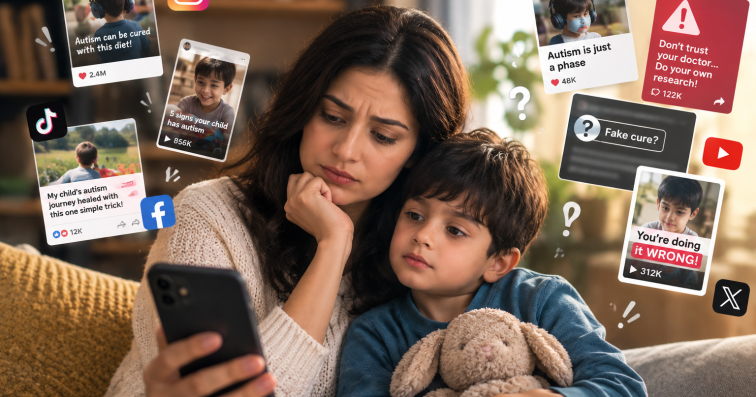

A few years ago, parents seeking answers about autism had to rely on doctors, therapists, books, and support groups. Today, information is available within seconds. A quick scroll through Instagram, TikTok, YouTube, or Facebook can expose parents to thousands of videos discussing autism symptoms, causes, therapies, success stories, and parenting strategies. Social Media Trends and Autism have therefore become an important part of how parents access and understand information.
While this accessibility has increased autism awareness worldwide, it has also created a new challenge: misinformation disguised as expertise.
Many parents find themselves wondering:
- Is my child autistic because they show a few traits mentioned in a video?
- Is this viral therapy really effective?
- Have I missed important signs because my child doesn’t look like the children shown online?
- Should I trust influencers over professionals?
The reality is that social media can be both empowering and misleading. Understanding the difference is crucial for making informed decisions about your child’s development and well-being.
Quick Answer: Are Social Media Trends Misleading Parents About Autism?
Yes, some social media trends can mislead parents by oversimplifying autism, promoting unverified treatments, encouraging self-diagnosis without professional assessment, or presenting autism as a one-size-fits-all condition.
However, social media can also be a valuable source of awareness, community support, and lived experiences when information comes from credible sources and is viewed critically.
The key is learning how to separate evidence-based information from viral content.
How Social Media Trends and Autism Content Can Mislead Parents

When a parent notices developmental differences in their child, they often begin searching for answers immediately. For many families, seeing another parent share a similar experience can feel comforting. It helps them realize they are not alone. The problem begins when personal experiences are presented as universal truths.
Social media offers:
- Instant access to information
- Personal stories from other families
- Practical parenting tips
- Emotional support and community
- Hope and reassurance
Common Ways Social Media Can Mislead Parents About Autism
1. Presenting Normal Childhood Behaviours as Autism Signs
Social Media Trends and Autism can sometimes make ordinary childhood behaviours appear to be definite signs of autism, such as:
- Lining up toys
- Avoiding eye contact occasionally
- Being shy
- Having strong interests
- Preferring routines
The truth is that many neurotypical children display these behaviours as well. Autism diagnosis involves a comprehensive evaluation of communication, social interaction, sensory processing, developmental history, and behaviour patterns not a single trait.
2. Promoting Self-Diagnosis Without Professional Evaluation
Social Media Trends and Autism discussions can make symptom checklists and short videos seem more reliable than they actually are.
Some online content encourages parents to identify autism solely through short videos or symptom checklists. While these resources may help parents recognize potential concerns, they cannot replace:
- Developmental assessments
- Clinical observations
- Standardized diagnostic tools
- Professional expertise
Every child develops differently, and accurate diagnosis requires a broader understanding of the child’s overall functioning.
3. Oversimplifying Autism
One of the biggest misconceptions social media creates is the idea that autism looks the same in everyone. In reality, autism is a spectrum.
This is another area where Social Media Trends and Autism content can create confusion for parents.
Some autistic individuals:
- Speak fluently
- Attend mainstream schools
- Live independently
Others may:
- Require substantial support
- Experience communication challenges
- Need assistance throughout adulthood
A 30-second video cannot capture the diversity of autistic experiences.
4. Creating Unrealistic Expectations
Many videos show remarkable developmental progress within a short timeframe. What viewers often don’t see is:
- Years of intervention
- Consistent family support
- Individual differences
- Professional guidance
Comparing a child to carefully edited social media content can leave parents feeling discouraged or inadequate. Every developmental journey is unique.
The Emotional Impact on Parents
Social media doesn’t just influence decisions, it influences emotions. Parents may experience:
Guilt: Did I miss the signs?
Anxiety: What if I’m not doing enough?
Confusion: One expert says this, another says the opposite.
Pressure: Everyone else’s child seems to be progressing faster.
These feelings are understandable. Parenting a child with developmental differences already involves uncertainty. Constant exposure to conflicting information can intensify stress and self-doubt.
When Social Media Can Be Helpful
Despite its challenges, social media is not inherently harmful. In fact, it can be incredibly valuable when used wisely. Parents can benefit from:
Learning About Early Signs: Awareness campaigns often help families recognize developmental differences earlier.
Hearing Lived Experiences: Autistic individuals sharing their perspectives can offer insights that textbooks cannot.
Building Community: Connecting with other families reduces isolation and creates opportunities for support.
Discovering Resources: Many parents learn about therapies, educational supports, advocacy organizations, and local services through social platforms. The goal isn’t to avoid social media, it is to use it thoughtfully.
The Bigger Question: What Are Parents Really Searching For?
When parents scroll through autism content late at night, they are rarely searching only for information.
They are searching for:
- Reassurance
- Understanding
- Hope
- Answers
- Connection
They want to know that their child will be okay. They want to know they are doing enough. They want to know they are not alone. And perhaps that is why social media has become so powerful it speaks directly to those fears and hopes.
Conclusion: Trust Your Child More Than the Algorithm
Social media can introduce us to valuable ideas, meaningful stories, and supportive communities. It can raise awareness and help families feel seen. But it can also blur the line between education and entertainment, expertise and opinion, evidence and virality.
Ultimately, Social Media Trends and Autism should be approached with curiosity, caution, and critical thinking.
As parents, it is natural to seek answers wherever they are available. Yet the most important truth remains unchanged: your child is not a trend, a hashtag, or a viral video.
Your child is a unique individual with their own strengths, challenges, personality, and potential.
The internet may offer clues, but it cannot tell the whole story. The most reliable guidance comes from combining professional expertise, evidence-based information, and your own understanding of your child. While algorithms are designed to keep you scrolling, your child needs something very different: your attention, your patience, your advocacy, and your belief in them.
Years from now, your child will not remember how many autism videos you watched or how many trends you followed. They will remember the parents who listened, learned, showed up, and loved them through every stage of their journey.
And that is something no social media trend will ever be able to replace.
Because the strongest voice guiding your child’s future should never be an algorithm, it should be the informed, compassionate, and unwavering voice of a parent.
Should parents trust influencers who share autism advice, or should they always verify the information with professionals?
Parents can find helpful experiences and ideas from influencers, but it’s important to verify autism-related advice with qualified professionals and reliable sources, especially when it involves treatments, medication, or health decisions
The point about ordinary childhood behaviors being framed as definite autism signs really stands out, since lining up toys or preferring routines can be typical at certain ages. I wonder whether the bigger issue is how short-form video removes all developmental context, like frequency, duration, and whether the behavior interferes with daily life. That context is exactly what clinicians weigh, so maybe the real gap is teaching parents what questions to ask rather than just which sources to avoid.
I’m very happy to discover this site it works great.
Thank you so much for your kind words! We’re happy to hear that you discovered our site and are finding it useful. We truly appreciate your support and encouragement.
This really resonates. I’ve seen so many parents in my circle spiral after a single TikTok video, convinced their toddler is autistic because he lines up his cars. The point about social media speaking directly to parents’ fears and hopes is spot on — that’s exactly what makes it so powerful and so risky.
I’d add one thing: the algorithm doesn’t just mislead parents, it can also delay real help. When every video offers a different explanation or “cure,” it’s easy to get stuck in research mode instead of booking an evaluation.
The line “your child is not a trend, a hashtag, or a viral video” is going to stay with me. Great reminder to use social media as a starting point, not a diagnosis.
Thank you for sharing such a thoughtful perspective. We completely agree that while social media can help parents find information and support, it should not replace a professional evaluation. We’re glad the message resonated with you, and we truly appreciate you adding this important point to the conversation.
“Awareness is powerful, but accurate information matters. Let’s replace myths with understanding and support every autistic individual with compassion and respect. ✨”