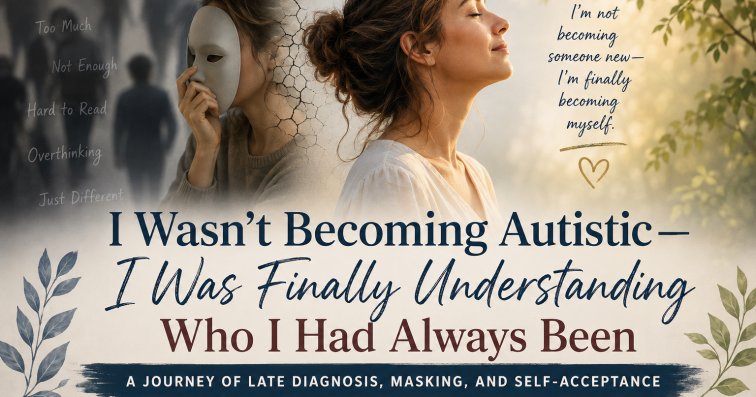
For most of my life, I knew I was different.
I just didn’t know there was a name for the difference.
I learned how to function by watching other people. I paid attention to how they talked, how they reacted, what they seemed to know instinctively, and what was expected of me in different situations. I learned how to adapt.
From the outside, that adaptation can look like success.
From the inside, it can feel like spending your entire life studying for a test everyone else seems to have been given the answers to.
I didn’t know I was masking.
I thought I was simply trying harder to be normal.
That distinction matters because when an autistic person goes decades without understanding why certain things are harder for them, they don’t necessarily conclude that their brain works differently.
Sometimes they conclude that they are the problem.
When Everything Has Another Explanation

For many women who receive an autism diagnosis later in life, autism isn’t the first explanation offered for their struggles.
It certainly wasn’t for me.
When you don’t fit the stereotype people have of autism, there always seems to be another possible explanation.
You’re anxious.
You’re emotional.
You’re too sensitive.
You’re difficult.
You’re overthinking.
You’re not trying hard enough.
You’re trying too hard.
You’re just quirky.
Eventually, other people’s explanations can become your own.
You stop asking, “Why is this difficult for me?”
Instead, you ask, “What is wrong with me?”
Those are two very different questions.
The first invites understanding.
The second invites shame.
For years, I accumulated labels and explanations without finding one that made the entire picture make sense. Some explanations described pieces of me. None explained the whole person.
Then autism entered the picture.
Suddenly, experiences that had seemed unrelated began connecting.
It wasn’t that autism magically explained every struggle I had ever experienced. Human beings are far more complicated than any single diagnosis.
But for the first time, I had a framework that made sense of patterns that had followed me throughout my life.
And that changed everything.
Masking Before You Know You’re Masking

One of the strangest parts of receiving an autism diagnosis later in life is realizing how many things you believed were simply parts of your personality may actually have been adaptations.
Masking can become so automatic that you don’t know you’re doing it.
You learn scripts for conversations.
You rehearse what you’re going to say.
You analyze interactions afterward.
You watch people’s expressions for clues about whether you’ve said the right thing.
You suppress reactions that other people consider excessive.
You force yourself through environments that overwhelm you because everyone else seems capable of tolerating them.
You imitate social behaviors that appear effortless for other people.
Eventually, the performance becomes familiar.
And when you’ve performed for long enough, an uncomfortable question emerges:
Who am I when I’m not performing?

That question became an important part of my own journey.
Unmasking wasn’t suddenly abandoning every social skill I had learned or deciding that nothing should ever make me uncomfortable again.
For me, it was much quieter.
It was beginning to notice when I was changing myself solely to make other people more comfortable.
It was recognizing when I needed recovery time instead of criticizing myself for needing it.
It was understanding that sensory overwhelm wasn’t a character flaw.
It was allowing myself to communicate more directly.
It was recognizing the enormous amount of energy I had spent trying to appear unaffected by things that genuinely affected me.
Most importantly, it was learning that understanding myself didn’t require rejecting everything I had become.
Some of the skills I developed while masking are still useful.
The difference is that now I can begin choosing when to use them rather than believing I must perform constantly to deserve belonging.
Diagnosis Didn’t Change Who I Was

People sometimes talk about receiving a diagnosis as though the diagnosis creates the condition.
It doesn’t.
I didn’t become autistic when someone finally recognized autism in me.
I had been living in the same nervous system, experiencing the same world, and developing ways to survive it long before autism had a name in my life.
The diagnosis changed my understanding of myself.
That’s different.
Imagine spending decades holding pieces of a puzzle without knowing what picture they’re supposed to create.
The pieces are real. You’ve always had them.
Diagnosis doesn’t manufacture new pieces.
Sometimes it simply gives you the picture on the box.
Suddenly, things that once looked like contradictions can exist together.
I could care deeply about people and still struggle socially.
I could be capable and still become overwhelmed.
I could accomplish difficult things and still struggle with things other people considered simple.
I could communicate well and still spend enormous amounts of energy figuring out communication.
I could be independent and still need support.
None of those things canceled the others out.
That realization brought something I hadn’t expected: compassion for earlier versions of myself.
Grieving What You Didn’t Know

Late diagnosis isn’t only relief.
There can also be grief.
You start looking backward.
What if someone had recognized this when I was a child?
What support might I have received?
What would have happened if I had understood sensory overload instead of believing I was overreacting?
Would I have chosen different relationships?
Would I have understood my boundaries earlier?
Would I have been kinder to myself?
Those questions don’t have answers.
That can hurt.
There is grief in realizing that younger versions of you were navigating something significant without the language to explain what was happening.
But I’ve learned that I can’t build a life entirely around the question of what might have happened.
Eventually, another question becomes more useful:
Now that I know, what am I going to do with that knowledge?
That question points forward.
Knowing Is Only the Beginning

Getting an answer doesn’t come with an instruction manual.
You can finally understand that you’re autistic and still have no idea what you’re supposed to do differently tomorrow morning.
I think that’s an important part of late diagnosis that sometimes gets lost in conversations about the relief of finally knowing.
Knowing is powerful, but knowing is the beginning.
I still had to learn what overwhelm looked like before I reached my breaking point. I had to start recognizing when I was saying yes because I genuinely wanted to and when I was saying yes because I had spent years learning that keeping other people comfortable was safer than disappointing them.
I had to think differently about boundaries, rest, communication, and what I actually needed.
And then there was another complicated piece: other people already knew a version of me.
When you’ve spent years appearing capable of tolerating something, people may not immediately understand why you’re suddenly saying that it’s difficult. When you’ve always pushed through, asking for an accommodation can look to someone else like you’ve changed.
But sometimes you haven’t become less capable.
You’ve simply stopped measuring your success by how much discomfort you can hide.
That’s a very different way to live.
Late diagnosis gave me language, but I still had to learn how to use that language without turning autism into another standard I had to perform correctly.
There isn’t one correct way to unmask.
There isn’t one correct way to be autistic.
Understanding myself has been less like arriving at a destination and more like finally having a map.
I’m still learning how to read it.
Faith, Identity, and Making Meaning

Faith has also been part of how I have made sense of this journey.
For a long time, I thought becoming a better version of myself meant correcting all the things about me that seemed different.
Now I see growth differently.
Growth doesn’t always mean becoming less of who you are.
Sometimes it means finally understanding who you have been all along.
For me, faith and autism don’t exist in separate compartments. My faith influences how I understand dignity, purpose, compassion, and the value of lived experience.
I no longer believe my worth depends on how convincingly I can imitate somebody else’s version of normal.
There is freedom in that.
Not because life suddenly becomes easy, but because the goal changes.
The goal is no longer to become acceptable.
The goal is to become authentic.
What Helping Professionals Need to Understand

My work in peer support and my education in social work have made me think deeply about what person-centered care actually means.
We talk a lot about meeting people where they are.
But doing that requires us to listen when someone’s lived experience doesn’t fit neatly into the framework we expected.
Late-diagnosed autistic adults may arrive in helping systems carrying years of previous explanations for their experiences. They may have become exceptionally skilled at appearing composed.
That doesn’t necessarily mean they’re not struggling.
Competence in one area doesn’t eliminate disability in another.
Eye contact doesn’t rule out autism.
Employment doesn’t rule out autism.
Parenthood doesn’t rule out autism.
Education doesn’t rule out autism.
Being articulate doesn’t rule out autism.
Having relationships doesn’t rule out autism.
And appearing socially capable doesn’t tell us how much energy maintaining that appearance requires.
Professionals need curiosity more than assumptions.
Instead of only asking, “Can this person do this?” we might also ask:
What does doing this cost them?
That question can reveal an entirely different reality.
Why Lived Experience Matters

One of the reasons peer support matters so much to me is that lived experience can reach places clinical knowledge alone sometimes cannot.
That doesn’t diminish professional expertise.
We need both.
Clinical knowledge can help us understand patterns, interventions, risks, and evidence.
Lived experience can tell us what those things feel like from inside a human life.
The most effective systems make room for both voices.
When someone says, “This is what this experience is like for me,” our first instinct shouldn’t always be to translate it into something more familiar.
Sometimes our job is simply to listen long enough to understand.
That’s especially important with autism because autistic people have historically been discussed extensively while their own perspectives were too often treated as secondary.
That is changing.
Autistic people are increasingly writing, researching, advocating, creating communities, and describing their own experiences.
Those voices matter.
Writing What I Needed to Read
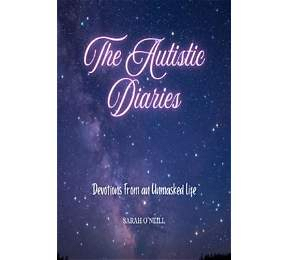
That desire to put lived experience into words eventually became part of why I wrote The Autistic Diaries: Devotions from an Unmasked Life.
I didn’t write it because I had autism completely figured out.
I wrote from inside the process of understanding myself.
I wanted to write about identity, masking, faith, acceptance, and the strange experience of looking backward at your own life with new information.
In many ways, I wrote something I wish an earlier version of me could have found.
Something that said:
There may be a reason you’ve always felt different.
Understanding yourself isn’t making excuses.
Needing support doesn’t erase your strengths.
Your accomplishments don’t erase your struggles.
And discovering you’re autistic doesn’t make you a different person.
It can finally give you language for the person who was already there.
There Is Life After the Label
A diagnosis is information.
What we do with that information can become transformation.
I’m still learning.
I’m still noticing masks I didn’t realize I wore.
I’m still figuring out which parts of my life genuinely fit me and which ones were built around expectations I thought I had to meet.
But I no longer see that process as evidence that something is wrong with me.
I see it as self-knowledge.
For anyone discovering autism later in life, I hope you give yourself permission to be curious about yourself.
You don’t have to reconstruct your entire identity overnight.
You don’t have to immediately know what unmasking looks like.
You don’t have to justify your diagnosis by proving how much you’ve struggled.
And you don’t have to throw away everything about the person you were before you knew.
That person got you here.
Maybe the next chapter isn’t about becoming someone new.
Maybe it’s about finally meeting yourself without the mask.
About the Author

Sarah O’Neill is a late-diagnosed autistic woman, peer support professional, Master of Social Work student, and author of The Autistic Diaries: Devotions from an Unmasked Life. Her writing explores autism, masking, identity, faith, resilience, and the value of lived experience.
How did Sarah’s understanding of herself change after learning about autism?
Sarah’s understanding of herself changed when she learned about autism. She realized that the differences and challenges she had experienced throughout her life had an explanation, helping her understand and accept herself better.
This post really resonated with me! I’m curious, how did you first start recognizing the ways masking affected your identity? It’s such a complex journey, and I appreciate your insights!
Thank you for sharing your thoughts! Masking can be a complex and personal experience. We’re glad the post resonated with you
This really captures how receiving an autism diagnosis later in life can bring a sense of understanding and self acceptance rather than feeling like becoming someone new
Thank you for sharing this thoughtful perspective.