

There are several theories about the association of symptoms of Autism, to the gut of the child. It has also been observed that several foods or types of foods, have an effect on the child’s behavior, and response. It could also be said that children with Autism face some trouble in getting the right kind of nutrition due to certain sensory processing difficulties. Hence, a modified, or a systematic diet plan becomes an essential part of the conventional interventions for Autism.
What is the role of proper diet and nutrition in Autism?
Often, the nutritional status in Children with autism remains compromised. It is seen that they usually have vitamin or other mineral deficiencies, such as, vitamin A, vitamin B6, vitamin B12 and folic acid deficiency. This could be a result of swallowing difficulties, sensory problems like food preferences, or gut related issues such as, diarrhoea, constipation, frequent infections, bloating and gastrointestinal (GI) pain. Issues such as not being able to sit in one place during meal times, could also be one of the reasons.
When things go awry in the "gut," negative behavioral changes and cognitive problems could occur or can get exacerbated. Hence, an autism diet plan with an alteration in the diet with respect to the nutritional requirement after assessing the other aspects like the swallowing and digestive ability is necessary so as to improve the quality of life of the patient.
Just like with other children, it could be challenging for a parent of child with autism, to ensure their child is receiving all the right nutrients in the right proportions. Hence, a healthy, nutritious and balanced, diet plan for autism needs can make a world of difference in their ability to learn, how they manage their emotions and how they process information.
Normally, diets such as the the Gluten-Free and Casein-Free Diet (GFCF), Specific Carbohydrate Diet (SCD), Body Ecology Diet (BED), and Lutein-Free Diet (Sara's Diet) are followed to help children on the autism spectrum.
What are the diet plans for my child with Autism?
You may find that there are several diet plans that are advised for Autism. However, it is advisable to consult with your child's nutritionist before starting with any particular diet plan. Currently, the few most commonly suggested diet plans for children with Autism, are:
-
Gluten-Free and Casein-Free Diet (GFCF)
The most specialized autism diet plan commonly prescribed for children on the spectrum is the Gluten free and Casein free diet (GFCF-diet).
There are several theories as to why the GFCF diet may be beneficial. One hypothesis is that individuals with Autism have difficulty digesting gluten & casein, causing the formation of peptides-gluteomorphin & casomorphin and their absorption into the bloodstream. These two peptides which appear to have chemical structure similar to opiates can cross the blood brain barrier and cause symptoms like delayed social and language skills & some behavioral issues.
Gluten and gluten-like proteins are found in wheat and other grains, including oats, rye, barley, bulgur, durum, kamut and spelt, and foods made from those grains. They are also found in food starches, semolina, couscous, malt, some vinegars, soy sauce, teriyaki sauce, flavorings, and artificial colors and hydrolyzed vegetable proteins.
Casein is a protein found in milk and foods containing milk, such as cheese, cream, butter, yogurt, ice cream, whey and even some brands of margarine. It also may be added to non-milk products such as soy cheese and hot dogs in the form of caseinate. The GFCF diet for autism mainly eliminates all wheat (and wheat products) and milk (and milk products). Although it may sound difficult, several alternatives are easily available.
-
Specific Carbohydrate Diet (SCD)
This diet excludes all complex sugars and starches (except honey & fruit sugar) in addition to gluten and casein. Eliminating sugars and starches starves out the yeast and bad bacteria (which feed on complex sugars), therefore helps reduce side effects created by yeast and bacteria overgrowth, which include gastrointestinal issues, headaches and hyperactivity.
In this diet for autism, meat, fish, eggs, nuts and seeds, certain beans, all non-starchy vegetables, and fruit are allowed. This is not a low carbohydrate diet but a specific carbohydrate diet. Diet focuses on non-starchy vegetables, fruit, honey, and certain beans for carbohydrates and avoids other sugars and starches.
-
Body Ecology Diet (BED)
The Body Ecology Diet is an anti-Candida autism diet plan focused on clearing up yeast and dysbiosis (imbalance of bad bacteria in the gut). Based on the concept of a natural balance of microorganisms that are involved in a range of functions in the body, and that this balance might be lacking in individuals with autism.
The three basic elements are adding cultured foods (such as yogurt and fermented vegetables), integrating "good" fats (flaxseed and extra virgin olive oil), and significantly reducing carbohydrate and sugar intake. Even if someone chooses a different diet, many of the Body Ecology principles can also be applied, such as the inclusion of fermented foods, soaking grains, and consuming more non-starchy vegetables full of minerals and alkalizing to the body. Fermented foods in particular are wonderful for supplying good bacteria that are known to reduce pathogenic bacteria such as clostridia, and for overall digestive and immune function.
-
Lutein-Free Diet (Sara's Diet)
This diet eliminates lutein, a pigment nutrient found in some fruits and vegetables such as spinach, corn, carrots, oranges and peaches. Lutein has been found to trigger severe allergic reactions, which often express themselves as gastrointestinal issues. This diet for autism also incorporates removal of soy and restriction of gluten and casein.
It is important to monitor and moderate the intake of certain additional food based substances while following any autism diet plan.
What food should I avoid for my child with Autism?
Simple sugars can be very hazardous to those with Autism. This increases the energy levels on a temporary basis which can be attributed to hyperactive behavior intermittently. Sugar substitutes like dates, honey can be used. Artificial sweeteners must be strictly avoided too. Artificial colors, flavors or any preservatives must be strictly kept at bay. Avoid big fishes as they are concentrated with toxins from the sea especially mercury, an immunotoxin that can lead to lowering the capacity of the immune system. Toxins like Monosodium Glutamate-MSG (ajinomoto used in Chinese foods) can cause over-excitation in the brain leading to hyperactivity, hence must be avoided.
What age can I start a diet for my child with Autism ?
It is better to start the special diet in consultation with your doctor and your Dietitian as soon as possible after diagnosis. Having said that, it is important that the child eats the alternative food options before eliminating any food from the child's diet.
Who can provide a good Diet plan for my child?
A specific diet or nutrition plan should only be started after consulting the child's pediatrician as well as occupational therapist. It should only be considered if the child is in need of specific and special dietary details.
A diet plan can be given by a qualified dietitian or nutritionist. Normally, ones pediatrician or occupational therapist can give a referral for a nutritionist. Our database online also has an exhaustive list of potential nutritionists and dietitians sorted by country, state, and city.
What type of food should I include in my child's diet?
As parents, it is important to work closely with the nutritionist to make sure to follow the specific diet and nutrition plan. It is also advisable for parents to help their children follow a rainbow diet that is a diet consisting of colorful vegetables and fruits. Parents can help introduce new vegetables and fruits slowly. The human brain needs lot of antioxidants, phytonutrients, vitamins and minerals to work its best.
All the mentioned nutrients are packed in veggies and fruits, and the use of probiotics in food can help soothe the gut and improve its functioning. Thus, these tips can help parents ensure the benefits of a healthy diet.
While following Gluten free diet gluten free alternatives like millets, quinoa, rice, sorghum, gluten free pasta, noodles, gluten free bread etc can be included.
While following Casein free diet casein free alternatives like coconut milk, rice milk, Almond milk can be included.
Points to remember
Do not include processed foods at all in the diet.
All foods should be as natural as possible.
Fruits and vegetables should be given raw and fresh.
Give small and frequent meals.
Give plenty of water daily.
Do not allow children to skip meal.
Make them chew food properly before swallowing.
If having difficulty in chewing change food consistency as per need.
Limit fried foodstuff.
Include the alternative food items before eliminating the restricted food items from the diet.
Maintain food dairy.
Try to incorporate colorful variety of food.
Read label carefully for gluten & casein.
All children on elimination diets should be under the care of a nutritionist.
What is Camel Milk?
Camel milk so called white gold of the desert is more similar to human milk than any other milk and differs from other ruminant milk because it contains low cholesterol, low sugar, high minerals (sodium, potassium, iron, copper, zinc and magnesium), high vitamin C, protective proteins like as Lactoferrin, lactoperoxidase, Immunoglobulins, lysozyme.
Benefits of Camel Milk for Autism
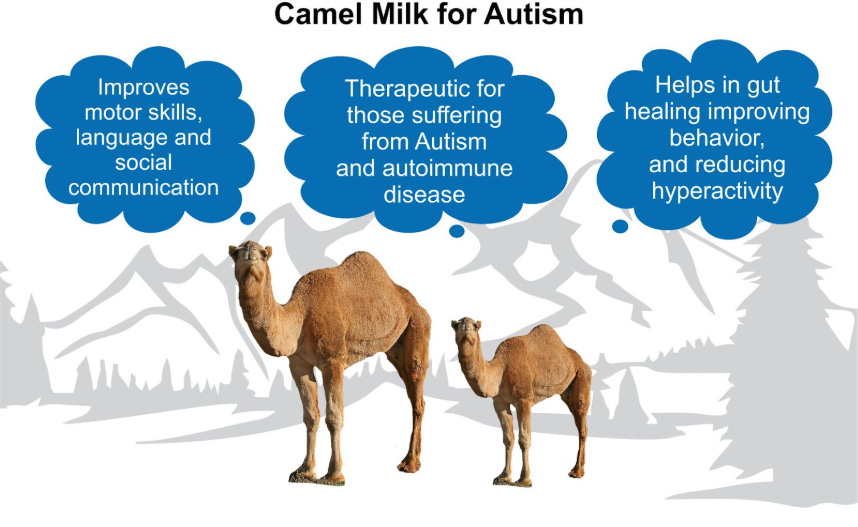
Autism disease is a general term for a group of complex disorders of brain development. The etiology of many autistic cases is based primarily on autoimmune disease, affecting an intestinal enzyme responsible for the formation of amino acids from the milk protein casein. Sometimes casein breaks down to powerfulopioid, casomorphin instead of primarily beta-casein and beta lactoglobulin. This opioid leads to typical cognitive and behavior symptoms due to brain damage.
The most prominent cerebral symptoms are caused by a malfunction in the formation of amino acids from two caseins in cow milk, beta-casein and beta-lactoglobulin Instead, a powerful opioid, casomorphin, is formed. This opioid elicits the cerebral symptoms of autism syndrome.
But Camel milk does not contain the two caseins that form casomorphin from cow milk, so symptoms do not develop. In addition, camel milk contains Igs necessary for initiating the immune system and nutritional advantages for brain development. Furthermore, camel milk has emerged to have potential therapeutic effects in autism.
The consumption of camel milk in children suffering from autism showed reduction in autism symptoms and improved motor skills, language, cognition, joint coordination and skin health.Research has also shown that children drinking camel milk have had amazing improvements in their behavior and diets.
The camel milk benefits for autism are also examined in several studies. The results of these studies show that camel milk for autism recovery is beneficial.
Camel milk also helps with autism spectrum disorder and brain conditions. A lot of parents have shared stories of their kids suffering from behavioral conditions. They claim that drinking camel milk has improved autism and other behavioral conditions in their kids. However, these anecdotes cannot serve the purpose of evidence.
The effects of camel milk on behavioral conditions in children have been studied in several studies. However, the number of subjects has been small. Researchers divided subjects into three groups. Researchers have compared the results of giving cow milk, raw camel milk and boiled camel milk to children with autism. The group that was given camel milk showed significant improvement.
Story of Camel Milk For Autism Spectrum Disorders
According to a patient report published in the National Center for Biotechnology Information, camel milk for autism has worked for a boy diagnosed with autism disorder at the age of 3. When the boy reached the age of 9, he started drinking one cup of raw camel milk a day. The boy experienced overnight improvements in autism symptoms. This regular raw camel milk consumption was associated with six consecutive years of sustained symptom improvements.
When the boy was 15 to 18 months old, he experienced the loss of language and attention. He also experienced the following symptoms:
Sensitivity to noise
Hyperactivity
Fixation on water and objects
Aggressive behavior such as biting
Interaction problems
Food allergies and intolerance
Auditory processing delay
Skin conditions
Intermittent tic disorder
Constipation
After a camel farmer told her about Middle Eastern hospitals using camel milk for babies, she started researching camel milk for autism. She spoke to people familiar with the use of camel milk for autism. After studying raw camel milk for two years, she decided to give her boy the goodness of non-allergenic and nutrient-rich camel milk. Her boy drank raw, unheated camel milk on October 10, 2007, for the first time and showed significant improvements in communication, eye contact, emotional expression and self-organization. He continued daily consumption of 4 oz of camel milk. He also showed improvements in vocabulary, language and other academic skills.
However, his behavior began to deteriorate when he stopped drinking camel milk for autism spectrum disorder. Symptoms were once again greatly improved after the boy resumed camel milk consumption. This story shows that camel milk for autism spectrum disorders along with medications and dietary management offers sustained benefits.
Camel Milk Nutritional Value
Camel milk has different nutritional characteristics from cow milk, but the proportions of nutrients can be highly variable based on a number of factors, including type and age of camel, climate, what it eats, and milking method. It can be used to make products such as yogurt and ice cream, but is not so easily turned into butter or cheese.
Casein is a major part of protein in camel milk. Camel milk has more digestibility and less allergic reactions in infants.
Camel milk differs from other ruminant milk as it contains low cholesterol, low sugar, high minerals, high vitamin C and higher protective proteins like Lactoferrin, lactoperoxidase, Immunoglobulins and lysozyme. Camel milk lacks of β-lactoglobulin and used as an option for the individuals intolerant to lactose of cow’s milk Camel’s milk is unique in terms of antioxidative factors, antibacterial, antiviral, antifungal, anti-hepatitis, anti-arthritis, treatment for paratuberculosis, prevents aging, remedy for autoimmune diseases and cosmetics. Insulin in camel milk is safe and efficacious in improving long-term glycemic control in diabetic patients. Camel milk reduces autism symptoms in children. Lactoferrin has the ability to inhibit the proliferation of cancer cell. Camel milk is rich in magnesium and zinc thus endowed with antiulcer properties. Camel milk has high α-hydroxyl acids which are known to plump and smoothes the skin and also used to treat skin disorders such as dermatitis, Acne, Psoriasis and Eczema. Although camel milk has such values, it’s less appreciated thus its consumption is restricted to pastoral area.
Camel milk is high in antioxidants, which help prevent damage to your cells that can lead to serious diseases such as cancer, diabetes, and heart diseases. Unlike other kinds of milk, camel milk has low levels of sugar and cholesterol and high amounts of vitamins and minerals, such as:
Potassium
Iron
Copper
Magnesium
Vitamin A
Vitamin B
Vitamin C
Vitamin D
Vitamin E
Calcium
Kalium
One cup of camel milk contains
107 calories
5.4 grams of protein
4.6 grams of fat
3 grams of saturated fat
11 grams of carbohydrates
8 grams of sugar
CONCLUSION
Many people have shared their experience of camel milk for autism spectrum disorder. Those who consume camel milk daily have a lot of positive things to say about it. People living in deserts have used camel milk for hundreds of years to treat many health problems. Even clinical studies show that camel milk for autism decreases oxidative stress and as a result, helps in autism treatment.
OTHER BENEFITS OF CAMEL MILK ARE:
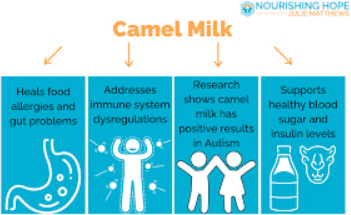
Anti-diabetic properties
Therapeutic effects of camel milk on cancer, tumor and ulcer
Camel milk effect as antiaging
Camel milk for treatment of Crohn’s disease
Treatment for allergies
Therapeutic effect camel milk on hepatitis
The risk factors of consuming Camel Milk for autism spectrum disorder
The risk factors for autism spectrum disorder include:
Environmental factors
Immune factors
Genetic factors
Neurochemicals
Treatment for allergies
Oxidative stress
Where To Buy Camel Milk
If you are living in a desert region, you don’t need to Google “where to buy camel milk” or “camel farm near me”. Camel milk is very readily available in desert regions. However, there are camel farms in the United States as well. You don’t need to drive to one such farm to purchase camel milk for autism. You can buy camel powder online. Desertfarms.com is a website that has started the camel milk revolution in the United States. The online store sells a range of camel milk packages. If you want to test camel milk before adding it to your diet, the website also offers a camel milk free trial package.
The camel dairy farming industry has grown in Australia and the United States, as an environmentally-friendly alternative to cow dairy farming using a species well-adapted to arid regions. It's highly sought after.About 5.3 million tons of the stuff is produced around the world each year, mostly coming out of Somalia.
Camel Milk USA. Millie Hinkle. ...
Sahara Camel Milk.
Hump-Back Dairy.
Oasis Camel Dairy.
Camel Culture.
River Jordan Camel Dairy..
Camelicious USA.
Advaik. India
Amul Camel Milk. India.